
You've done the journaling. You've read the books about attachment theory. You've sworn off a type. You've made the lists of green flags. You've told yourself — firmly, decisively, this time — that you're only accepting real love. Full presence. Someone who actually shows up.
And then it happens again.
Maybe it's the person who was perfect for six weeks and then slowly, inexplicably, disappeared. Maybe it's the one who needed so much space you felt like you were loving a ghost. Maybe it's the brilliant, magnetic, emotionally unavailable person you knew — knew — you shouldn't get attached to.
And yet.
If you're exhausted from this pattern and wondering if something is fundamentally wrong with you — I want to say this first, clearly: there is nothing wrong with you. But there is something happening inside you that this pattern is trying to point you toward.
And until you understand it, you will keep recreating it. Not because you're weak, not because you're naive, but because patterns this consistent are never random.
Why the "Just Choose Better" Advice Doesn't Work
Every breakup, every situationship that dissolves into confusion, every relationship that starts perfect and ends in emotional whiplash — they all come with the same well-meaning advice from friends:
"You need to have higher standards." "Just stop falling for unavailable people." "You should know better by now."
Here's the hard truth about that advice: it treats the symptom while leaving the cause untouched.
Choosing different people requires being a different chooser. And that means understanding why emotionally unavailable people feel so familiar — often so comfortable — in a way that consistently available people... don't.
That discomfort with availability? That's the data.
The Nervous System Explanation Nobody Gives You
What your nervous system calls "chemistry" is largely a recognition signal.
When you meet someone new, your brain and body are doing a rapid, subconscious assessment: Does this feel like what I know? Is this frequency familiar?
If you grew up in an environment where love was inconsistent — a parent who was warm sometimes and distant other times, affection that had to be earned, connection that came in waves and withdrawals — your nervous system learned to read that specific frequency as love.
Not because it was healthy. Because it was home.
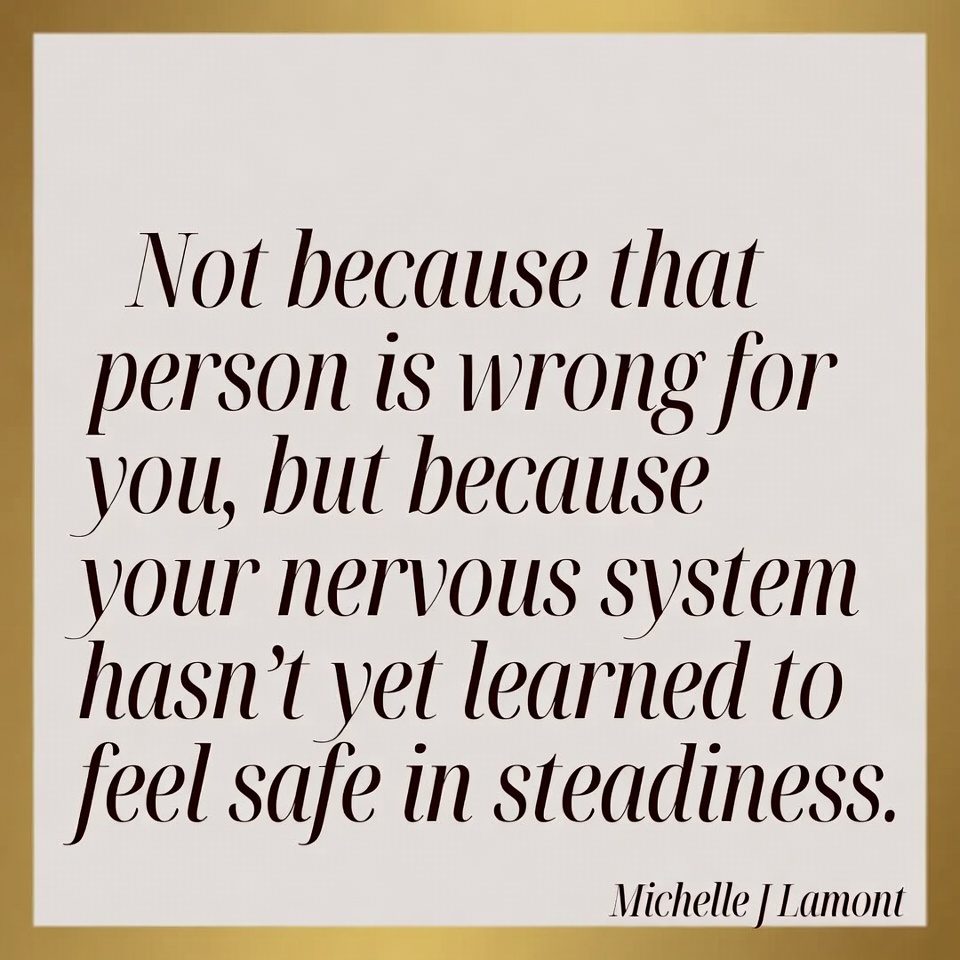
So when you meet someone emotionally available — consistent, present, clear — it can actually feel boring. Or suspicious. Or suffocating. Not because that person is wrong for you, but because your nervous system hasn't yet learned to feel safe in steadiness.
And when you meet someone emotionally unavailable — hot/cold, mysterious, just out of reach — it activates you. It creates urgency, hope, that electric feeling of wanting. Your nervous system isn't being stupid. It's recognizing a familiar pattern and flooding you with the neurochemical cocktail it associates with "love."
This is why knowing better doesn't automatically help you do better.
The Four Hidden Patterns Behind "Unavailable" Attraction
1. The Anxious Attachment Loop
If your early caregivers were inconsistent — loving and present when things were good, withdrawn or unpredictable when stressed — you likely developed anxious attachment. This means your nervous system learned that love requires vigilance. That you must track the other person's moods constantly, manage their distance, work to pull them close.
Unavailable people recreate this dynamic perfectly. They give you something to work for. And the pursuing, the hoping, the getting close and then being pushed away — all of it confirms the story your nervous system already believes: love is something you earn, not something you have.
2. The Familiar Wound
Often the unavailable people we're drawn to mirror a specific unresolved relationship — usually a parent, sometimes a sibling, sometimes an early loss. Something in their particular brand of distance feels like a chance to finally win the love that felt out of reach then.
This isn't conscious. You don't sit across from someone and think, "You remind me of my emotionally unavailable father and I'd like to re-enact that dynamic." But the pull toward them has that energy underneath it.
3. The Worthiness Deficit
Some of us don't attract unavailable people because we're hooked on the chase — we attract them because some part of us genuinely doesn't believe we deserve consistent love.
Someone who is warm, attentive, and emotionally present triggers an alarm: They can't really want me. When they find out who I really am, they'll leave. So we unconsciously choose people who are already withholding, who confirm what we've feared all along, who give us a reason to keep love at a distance.
Unavailable partners feel safer. You can't be fully rejected by someone who was never fully there.
4. The Soul Contract
This is the layer most coaches and therapists won't go to — but it's the one I find most profound.
Some of the recurring relationships in your life aren't accidents. They are assignments. The people who keep showing up in the same emotional costume are showing up to teach you something specific about yourself that you haven't yet learned.
The lesson isn't how to pick better people. The lesson is always about you — your relationship to yourself, your willingness to value yourself, your capacity to receive love without earning it.
When you complete the lesson, the pattern stops.
What Actually Breaks the Pattern
I want to be honest with you: this is not a quick fix. Anyone selling you a "how to attract your person in 30 days" program is selling you strategy when you need surgery.
Real pattern interruption requires three things:
1. Safety inside yourself first. You cannot receive consistent love from another person until you can provide consistent love to yourself. Not as a slogan — as a practice. This means learning to be with yourself without constant external validation. Learning to soothe your own nervous system. Learning to trust your own perception.
This is regulation work. Somatic work. Inner work. It is not glamorous, but it is transformative.
2. Grief. Most people skip this step. Before you can fully choose something new, you have to grieve what didn't happen — the parent who wasn't available, the childhood where love felt conditional, the version of yourself that kept trying and kept coming up empty.
Unprocessed grief keeps you circling back. It keeps the old patterns alive because some part of you is still hoping the story will end differently.
It won't. But when you grieve it — really grieve it — you stop needing it to.
3. Building the tolerance for being loved. This is the most counterintuitive step. When someone safe, consistent, and emotionally present shows up — you will likely feel the urge to push them away, minimize their interest, or create drama to make it feel more "alive."
That urge is your nervous system trying to return to familiar territory. Recognizing it as a survival pattern rather than a read on reality is the practice.
Stay. Let yourself be seen. Let the steadiness be safe rather than suspicious. This takes time. It takes repetition. It takes learning a new frequency.
A Note About What You Actually Deserve
I've talked to thousands of people who came to me exhausted from this exact pattern. And almost every single one of them — underneath the exhaustion — was carrying a belief that safe, real, available love was somehow not for them.
For other people, maybe. Not for them.
I want to name that belief directly, because until you name it, it runs you.
You did not arrive in this life deserving less love than anyone else. Whatever happened to make you believe otherwise — that was a lie that got installed in you before you had the tools to reject it.
The work of your life is not to find the right person. It is to become the person who allows love in. And that person? Already exists inside you. The patterns we've been discussing aren't who you are. They are protective strategies that kept a younger version of you safe.
You don't need them anymore.
The Pattern Ends When You Decide to Understand It
You asked why you keep attracting unavailable people. The honest answer: because something in you is still available to that pattern. Still finds it familiar. Still, in some quiet corner, believes it's what you deserve or what you can handle.
That is not a life sentence. It is an invitation.
When you do the work to understand what the pattern is teaching you — and complete the lesson — you won't have to white-knuckle your way to better choices. You'll simply stop being attracted to what used to hurt you.
That's the miracle. Not magic. Not manifesting a person. But becoming someone whose inner world has expanded enough to hold real love.
That person is who you came here to be.