By Michelle J. Lamont | TEDx Speaker · Yale Happiness Expert · Host, Manifesting Miracles
Why Do I Feel Stuck No Matter How Hard I Work?
You're doing everything right.
You wake up early. You show up. You hustle harder than almost everyone you know. You've read the books, taken the courses, listened to the podcasts. You tell yourself it's only a matter of time.
And yet — you open your bank account and your stomach drops. Again. You're working more hours than ever, making more money than you used to, and somehow still feel like you're standing in quicksand. Like no matter how fast you move, you're not actually going anywhere.
If that's where you are right now, I need you to hear something: you are not broken. You are not failing. And the answer is almost certainly not "work harder."
The reason you feel stuck has very little to do with your work ethic. And everything to do with something most success coaches will never talk about.
The Question Nobody's Asking
When people feel stuck, the first place they look is strategy. Am I in the wrong career? Should I get another degree? Do I need a better morning routine?
Those aren't wrong questions. But they're surface questions.
The deeper question — the one I spent years avoiding myself — is this: What part of you believes you don't deserve to move forward?
That might sound woo-woo. I promise you it is not.
I'm a Yale-certified Happiness Expert, a Master Certified Coach, and I've worked with thousands of people who were doing everything "right" and still felt exactly where you are now. And across every age, every income bracket, every industry — the pattern is almost always the same.
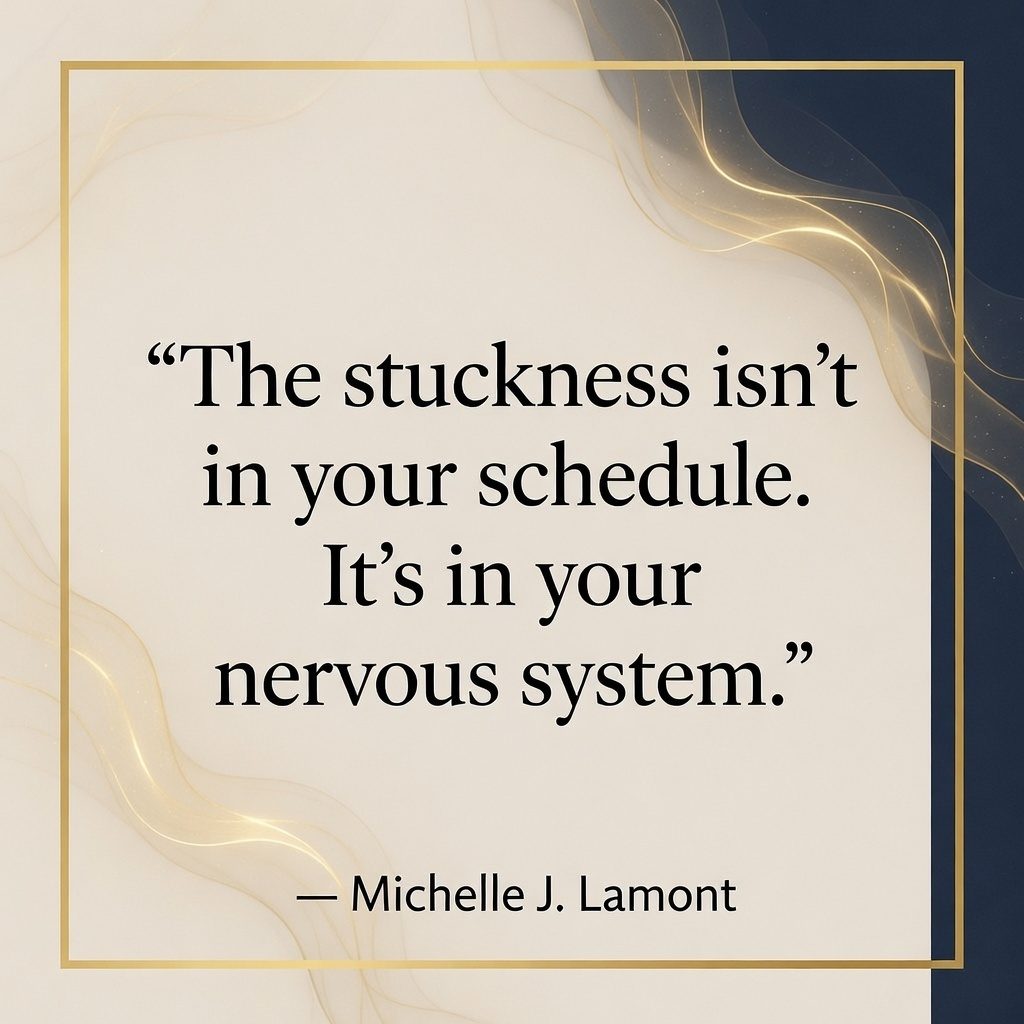
The stuckness isn't in your schedule. It's in your nervous system.
What "Stuck" Actually Is (The Science Nobody Told You)
Here's what's happening physiologically when you feel stuck despite working hard.
Your nervous system has a function called threat detection. It is constantly, silently scanning your environment — not just for physical danger, but for any signal that your survival, your belonging, or your worthiness might be at risk.
When we grow up in environments where money was scarce, where love was conditional, where being "too much" or "not enough" had real consequences — our nervous system learns a set of invisible rules. Rules like:
Success means abandonment (because the people who got ahead in your family left, or were resented)
Making more money is dangerous (because it changed relationships, brought conflict, or attracted the wrong attention)
Wanting more is selfish (because someone told you that, directly or indirectly, over and over)
These aren't conscious beliefs you chose. They're survival programs your nervous system installed to keep you safe.
And now, every time you get close to a breakthrough — a raise, a new client, a relationship upgrade, a level of visibility you've never had before — your nervous system fires the alarm. This is dangerous. Pull back. Stay small. Stay safe.
You don't feel it as fear. You feel it as exhaustion. Procrastination. Distraction. Sudden self-sabotage you can't explain. The feeling of running as fast as you can and going nowhere.
That is not a work ethic problem. That is a nervous system problem.
The Three Most Common Hidden Blocks (And How to Recognize Yours)
1. The Ceiling You Inherited
Most people's income ceiling is set not by their skill level, but by the highest level of financial comfort they witnessed growing up — and the stories attached to it.
If money was always a source of stress, conflict, or shame in your household, your nervous system learned: money = pain. So when you start to earn more, something in you creates conditions to bring you back to what feels familiar.
Ask yourself: What is the highest income the adults I grew up with ever consistently had? And how did they talk about people who had more?
The answers will tell you a lot about your ceiling.
2. The Exhaustion Loop
There's a specific kind of burnout that comes from working hard and feeling unsafe. It's not just tired — it's the particular exhaustion of running while holding your breath. Of performing success while secretly waiting for the floor to drop out.
This is survival mode. And from survival mode, you cannot build. You can only maintain. Or collapse.
The tragic irony is that the harder you push from survival mode, the more you confirm to your nervous system that you are, in fact, in danger. So it keeps the alarm on. So you keep pushing. So it keeps sounding. Around and around.
3. The Identity Mismatch
Sometimes the block isn't fear — it's identity. You simply have not yet become the version of yourself for whom the next level is normal.
Think about it: if someone handed you 10x your current income tomorrow, would you feel like it was yours? Would you know what to do with it? Would it feel safe, deserved, and sustainable?
For most people, the honest answer is no. Not because they don't want it — but because they haven't done the interior work of growing into it.
Money, love, success — they don't stay where they don't feel at home.
What Actually Moves the Needle
I've lived this. I didn't grow up with a template for the life I now have. I had to learn — sometimes painfully, sometimes beautifully — that my outside world could not transform until my inside world did.
The work that actually creates movement isn't more strategy. It's identity expansion. It's nervous system regulation. It's learning to feel safe in your own forward motion.
Here's what that looks like in practice:
Step 1: Name the ceiling. Get specific. What is the exact number, level, or outcome that has felt perpetually just out of reach? Write it down. Then ask: What story am I telling about what it means to reach that?Step 2: Trace it back. Where did you first learn that this specific thing was dangerous, selfish, out of reach, or not for people like you? You don't need years of therapy to do this — you just need honest curiosity.
Step 3: Regulate before you generate. Before your next big push, ask: Am I operating from a state of safety, or from a state of fear? If you're operating from fear — tightness in your chest, scarcity thinking, desperate energy — you will produce results that match that frequency. Slow down. Breathe. Get regulated. Then move.
Step 4: Build evidence. Your nervous system doesn't respond to affirmations. It responds to evidence. Start small. Create wins that your body can register as safe. Over time, your system recalibrates. The ceiling rises. The stuckness lifts — not because you worked harder, but because you stopped working against yourself.
The Thing About "Manifesting"
People come to manifestation because they feel like they've exhausted every conventional route. And I understand that completely. But what I teach — what I've lived — is that manifestation is not wishful thinking. It is not vision boards and waiting.
It is the deep, disciplined, sometimes difficult work of becoming someone whose internal state is aligned with what they say they want.
You cannot think your way out of a survival pattern your body is running. You have to feel your way out. And that requires a kind of inner work that most productivity advice doesn't touch.
That's the work I do with the people I serve. The 2am people. The ones who have tried everything and are still asking why. The ones smart enough, capable enough, hard-working enough — who just can't seem to get out of their own way.
If that's you, I want you to know: the answer exists. You are not the exception to transformation. You are exactly who this work was designed for.
You're Not Stuck. You're Ready.
The fact that you're asking this question — why do I feel stuck no matter how hard I work? — is not a sign of failure. It's a sign that you've hit the edge of what willpower and strategy alone can do.
The next level of your life is not waiting for you to work harder. It is waiting for you to work differently. To do the inner work that the outer work has been standing in for.
That's where everything changes.
Michelle J. Lamont
TEDx Speaker · Yale-certified Happiness Expert · Master Certified Coach · Host of Manifesting Miracles (Top 1% Global, 650K+ downloads) · Founder of MMA (Manifesting Miracles Academy) Learn more at michellejlamont.com